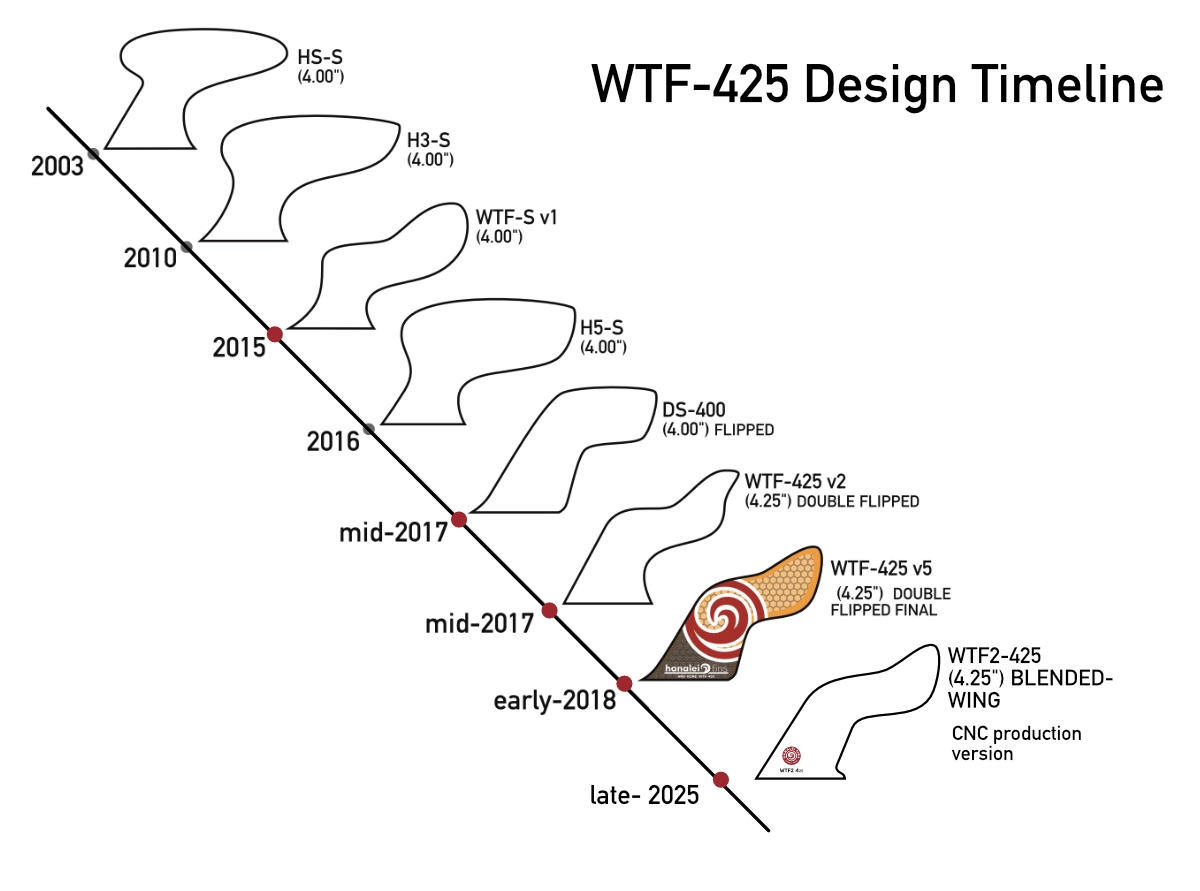
Hey, remember that timeline we shared ages ago that showed how we got to the WTF design? Well, guess what? It’s making a comeback this year as a CNC production fin, and we’ve given it a few design tweaks and improvements to make it even better! So, we’ve updated the timeline to include the new template.
I was thinking it would be cool if everyone could peek at the timeline of how the WTF-425 fin design came to be and see how the shape evolved over time!
It all started in a time long ago with the original design for the HAMMER (HS-S) fin. The idea behind this fin was minimal base for speed an turning, large blade for drive and control, and lots of blade extension for hold. This fin was a revelation in the day!
This then progressed to the H3-S, which is still in service (yes, there were a couple of other versions in between, but we did not produce them in HRD-KORE).
One day I was looking at the H3 wondering how I could add a little more feel into the design and came up with the original WTF-S template. The idea was to build on some of the characteristics of the H3, but shift some of the blade area into a more distinct tip at the back tip of the fin to enhance the feel. This lingered for awhile as there was some magic ingredient missing.
In the meantime, another H5-S hammer design came about with a more pronounced but shorter blade. the other design change was the introduction of a hollow foil on the inside face. Up until this design all of the hammer designs had flat inner face with 70/30 leading edge foils.
Then I got side tracked by a design that had been lingering around for a couple of years that I resurrected as the DS-400. At this time we were starting experiment with the flipped tips based on the foil board wing designs we had done.
The decision was made to give this design something special, which was to flip the entire blade out by 6º. The idea behind this was that it would really help the fin transition through turns as there would be two distinct surface to work off.
No sooner had one of these been made than the original WTF design came to mind and we realized that flipping that design would be the missing piece of the puzzle. So the v2 version of the WTF was foiled. It had a 6º flip in the blade and another 16º of flip in the tip. The tip was flat on the inside face. This design worked well but it was not as versatile as it could have been.
So finally we came up with the WTF-425 v5 (it progressed through a few variations and minor refinements) that had a large smooth tip, the base and mast of the DS, a little more area to the blade, and the same flip angles as the v2 version. A hollow foil was added to the tip. Also the hollow foiling on the inside face was radically tweaked to try and force the water to flow out the tip as the pressure built up on the blade.
THIS WAS IT!
We spent a lot of time testing it (mahalo Mitch, Kevin & Chance) with a wide range of other fins in quad and thruster setups. No matter what was thrown at this fin in terms of wave size it just handled it, super fast, really a lot of drive through turns, and stable with lots of feel. In a way it is like a super canard fin in a quad setup, when setup as the front fin, where the fin really helps transition the board onto the back fin.
Sorry about the length of this post but thought people might find it interesting to see how a design like this evolved. It certainly was not created in a vacuum. Lots of talk story!
BTW, it is worth mentioning that there was actually one other fin that started this whole chain of events, the very first design that was done in 1972 in Jeffreys Bay, South Africa - the venerable THUMB fin design! We still make this original design to this day in the form of the TS and TSN longboard center fins. What a long journey it has been.
Fast forward to 2025, and we are finally bringing this design into our CNC production pipeline. After much experimenting, we have figured out how to efficiently CNC machine this fin. It required some alterations to the original design. Firstly, it now uses the BLENDED-WING concept instead of the original double-flip. Secondly, the throat was redesigned to be a better lifting surface and to move the fin slightly forward on the base. These design changes also resulted in the tip of the fin getting a lot thinner, so there is now a lot more flex in the tips. Additionally, the upper blade has been lengthened in order to put the wing further back for improved hold and to help induce more lateral flex.